Custom CRM or Ready-Made System? When a Business Needs Individual CRM Development
CRM has long ceased to be just an electronic notebook for a manager.
A modern CRM system can control the entire client journey: from the first inquiry to a repeat purchase, automate the work of managers, store communication history, control sales, form analytics and transfer data to other systems.
But at some point a company faces the question:
buy a ready-made CRM or develop its own?
At first glance a ready-made solution seems an obvious choice. It can be quickly connected, configured and started to be used.
However, every business has its own processes.
And if a company has a non-standard sales model, complex work logic, a specific calculation system, its own platform or a large number of integrations, a ready-made CRM can turn into a constant compromise.
In such cases, the development of a CRM system tailored to the needs of a specific business comes to the forefront.
Webstick Global is engaged in the creation of custom CRM solutions and develops systems adapted to the company’s business processes. More details about the service can be found on the CRM systems development page.
What should a CRM actually do?
The main task of CRM is not just to store contacts.
It should help the business manage relationships with clients.
A typical CRM may include:
- client base;
- client card;
- communication history;
- sales funnel;
- tasks;
- reminders;
- documents;
- orders;
- payments;
- reports;
- analytics;
- automation;
- integrations.
But real value arises when CRM repeats the real processes of the company.
Why does a ready-made CRM not always fit?
Ready-made systems have a huge advantage — a quick start.
But along with this the business receives limitations.
For example, a company may want to change the funnel logic.
A ready-made CRM allows this only partially.
Or the business has a complex system of distributing requests among managers.
The system does not support this.
You can try to create a workaround.
Then another one.
Then connect an additional service.
In a year the company receives a system of dozens of integrations, tables and manual operations.
In such a situation, its own CRM may turn out not to be a more expensive alternative, but a way to simplify the business architecture.
Custom CRM as a digital model of the company
The main advantage of custom CRM is that it is built around the business.
The business does not adapt to the program.
The program adapts to the business.
For example, a company may have:
Lead → qualification → calculation → approval → contract → production → delivery → payment → repeat sale.
Instead of forcing a manager to transfer data between five systems, CRM can unite this process.
As a result, one client record becomes a source of information for different departments.
CRM for sales
One of the most common scenarios is sales automation.
The system can show:
- new leads;
- active deals;
- potential sales amount;
- responsible manager;
- next step;
- contact deadline;
- client history.
A manager sees not just a list of managers, but the real state of sales.
This allows finding problems even before they turn into financial losses.
CRM for complex B2B
In the B2B segment a sale often consists of dozens of operations.
One client may have:
- several contracts;
- several legal entities;
- different payment conditions;
- several managers;
- different types of products;
- repeat orders.
A simple CRM with fields “name”, “phone” and “status” no longer solves the task here.
A system that understands the structure of the business is needed.
New Rain USA case
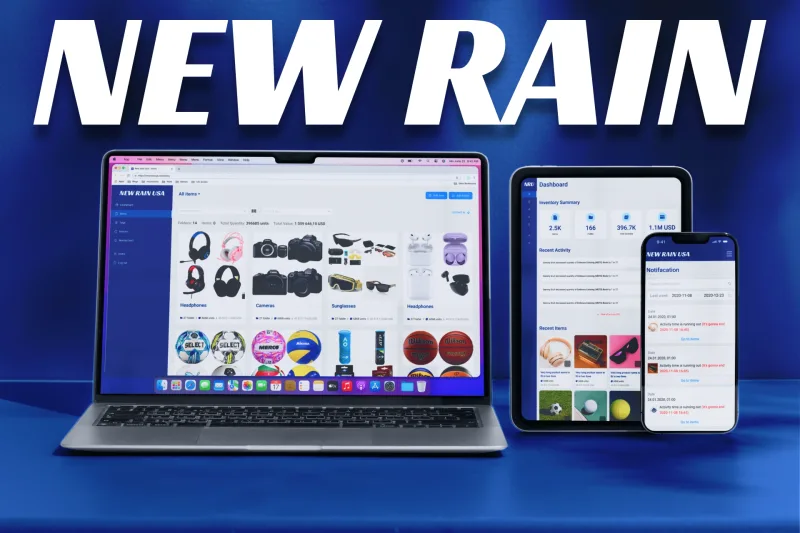
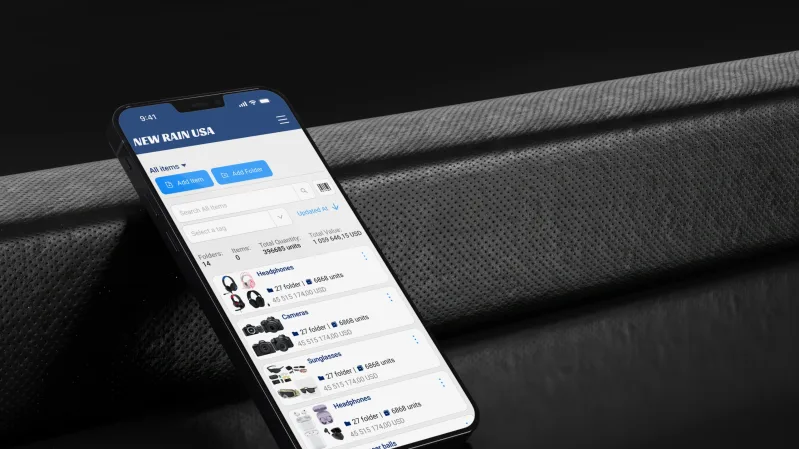
A good example of custom CRM is New Rain USA: CRM system development.
The project involved the creation of a system for managing the company’s business processes. Instead of using a standard product, an individual solution was implemented taking into account the specifics of the client’s work.
Such projects demonstrate the key advantage of custom software:
the architecture is created for a specific business model.
CRM should not exist separately from other systems
A modern CRM is rarely the only system of a company.
It can interact with:
- website;
- online store;
- mobile application;
- ERP;
- telephony;
- email;
- messengers;
- payment systems;
- marketing platforms;
- warehouse.
For example, a user fills out a form on the website.
The request automatically goes into CRM.
The manager receives a notification.
After contact the status changes.
After concluding a deal the data is transferred to ERP.
After payment the client receives a message.
All this can work without manual data transfer.
CRM as a center of automation
This is another important trend.
CRM is gradually becoming not just a client base, but a center for managing the customer journey.
The system can automatically launch scenarios:
if a client left a request → assign a manager.
if the manager did not contact → remind.
if the deal moved to a new stage → create a task.
if the client made a purchase → launch a follow-up.
if the client has not bought for 90 days → form a segment for reactivation.
Thus, CRM takes on a significant part of routine work.
EMIH case
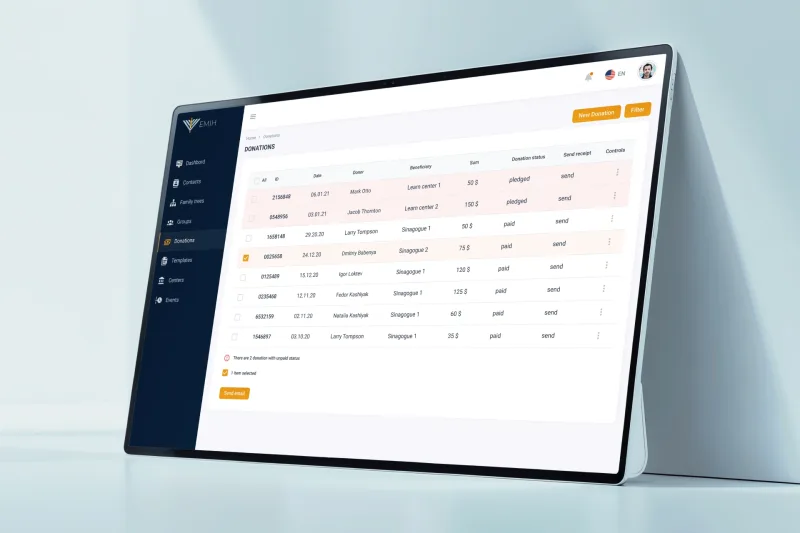
In the EMIH case — CRM system development, Webstick Global implemented an individual CRM solution tailored to the client’s needs.
The very format of the project shows that CRM can be not a boxed product, but a specialized system that becomes part of the company’s internal IT infrastructure.
This is especially important for companies where the standard sales logic does not correspond to the real work process.
CRM for order automation
Another interesting scenario is automation of work with a large number of orders.
If managers process dozens or hundreds of operations every day, manual data entry creates a risk of errors.
CRM can automate:
- order creation;
- distribution;
- status changes;
- payment control;
- communication;
- document generation;
- transfer of information to other systems.
This allows employees to focus on the client, and not on transferring information between tables.
Beerstation case
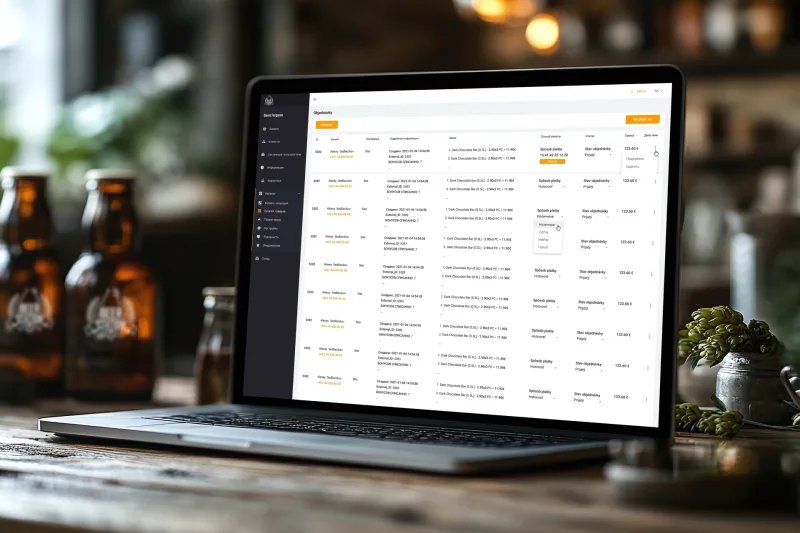
An example of such an approach is Beerstation — CRM system development.
The Webstick Global project was aimed at creating a CRM system for managing Beerstation’s business processes.
This case well demonstrates another principle of custom CRM:
the system should reflect the real operational model of the company, and not an abstract “ideal CRM”.
Analytics: CRM should show not only the past
A manager is not enough to know how many deals were closed.
They need to understand:
- how many leads are currently in work;
- what the projected revenue is;
- where delays occur;
- which managers have the best conversion;
- which sources give quality leads;
- how much it costs to attract a client;
- where clients most often refuse.
Therefore a modern CRM should include a dashboard and an analytical level.
AI in CRM
Artificial intelligence opens new opportunities for CRM.
For example, AI can help:
- predict the probability of closing a deal;
- analyze correspondence;
- automatically classify leads;
- form a summary of negotiations;
- propose the next action to the manager;
- find risky deals;
- predict client churn.
In the future a manager will work not just with a database, but with an intelligent assistant.
For example:
“Which clients are highly likely to buy this month?”
CRM analyzes the data and forms an answer.
When is it worth ordering your own CRM?
There are several characteristic signals.
- The business has a non-standard sales process
If a standard funnel does not fit, custom CRM may be a better solution. - Many integrations are needed
If CRM must work with dozens of internal and external systems, individual architecture can significantly simplify the work. - The company has its own digital product
CRM can become part of SaaS, a marketplace or another platform. - A large number of manual operations
If employees regularly transfer information between tables, systems and email, this is a signal for automation. - The business is scaling quickly
A system that worked with 10 managers can become a bottleneck with 100.
How much does CRM development cost?
As with mobile products, there is no universal price.
The cost depends on:
- number of roles;
- modules;
- complexity of business logic;
- integrations;
- number of users;
- level of automation;
- analytics;
- security;
- mobile client;
- AI functions;
- administrative part.
Therefore the best way of evaluation is to first form requirements, and only after that determine the architecture and budget.
How does CRM development proceed?
A typical process can be built as follows:
- Business analysis
Study of processes and roles. - Requirements formation
Definition of functions and integrations. - Design
Creation of system architecture. - UX/UI
Development of a convenient interface. - Backend
Implementation of business logic and API. - Frontend
Creation of the user part. - Integrations
Connection of external systems. - QA
Testing. - Launch
System deployment. - Support
Further development.
Why is it important to start with business processes?
The worst scenario is to tell the developers:
“We need a CRM.”
And not explain how the company works.
CRM cannot be effectively developed without understanding:
- who sells;
- to whom they sell;
- how a request is formed;
- who processes it;
- what stages there are;
- what documents are used;
- how payment proceeds;
- what happens after the sale.
That is why Webstick Global, when creating CRM solutions, works not only with programming, but also with the business logic of the digital product.
On the CRM systems development page the direction of creating CRM solutions for specific business tasks is presented.
Conclusion
A ready-made CRM is an excellent tool if its capabilities are sufficient for the business.
But when a company starts changing its own processes for the sake of a program, the question arises: maybe it is time to do the opposite?
The business should not adapt to CRM. CRM should work for the business.
Custom CRM is especially relevant for companies with complex sales logic, a large number of integrations, non-standard processes and high automation requirements.
Webstick Global has experience creating custom CRM systems for different types of business.
If a ready-made CRM no longer meets the company’s needs, the Webstick Global team can help design and develop an individual system.
More details about CRM development by Webstick Global and implemented projects can be found on the company’s website.